
Why Strategy Execution Isn’t Enough to Create Change
Execution feels good because it feels productive. We’re getting things done, checking off tasks and activities, holding the meetings we said we’d hold, communicating the change to our teams, sending out the feedback form or staff survey to measure what’s happening. There is a sense of forward momentum because there is visible activity.
For many leaders, especially those reporting to a board, that matters. They have deliverables to meet, they want to show that things are moving, and they want their people to feel that the organization is making progress.
The challenge is that execution is still only execution. We are getting things done.
And while completing work can absolutely move a strategy forward, it can also create the impression that change is happening when, underneath all that activity, the organization is still operating in much the same way it always has.
If we are genuinely trying to create change, meaning we are asking people to do new things in new ways, execution alone will not get us there. New ways of operating require new capabilities, new behaviours and, over time, different ways of making decisions and setting priorities.
Why execution can look a lot like change
I saw this time and time again when I worked in the social services sector. We had great aspirations and strategic pillars. We had mission, vision and values. But that was often where it ended.
Those ideas sat on a website or appeared in presentations, but they were rarely part of the conversation when we were making day-to-day decisions. I didn’t think about them as they related to my own work or how my teams operated.
I remember being part of a branding session where we defined our aspirations based largely on who we already were as an organization, rather than who we wanted to become. We operated within the status quo because it worked and because it was what we had always done.
So we continued to execute on what we already knew how to do.
Nothing about the strategy required me to shift what I focused on, how I led my team or how I delivered services. And if the people across an organization can continue working exactly as they did before, it is worth asking how much change the strategy is actually creating.
Activation requires something to actually change, not just move
If your strategy genuinely asks your organization to do new things in new ways, you cannot rely on execution alone.
New ways of operating require new capabilities.
This is one of the biggest tell-tales I see when looking at a strategic plan. If the plan describes significant organizational change but includes no serious investment in helping people develop the capabilities required to make that change, I have questions.
And when I say training, I do not mean the one-day off-site or the third-party leadership course everyone gets sent to.
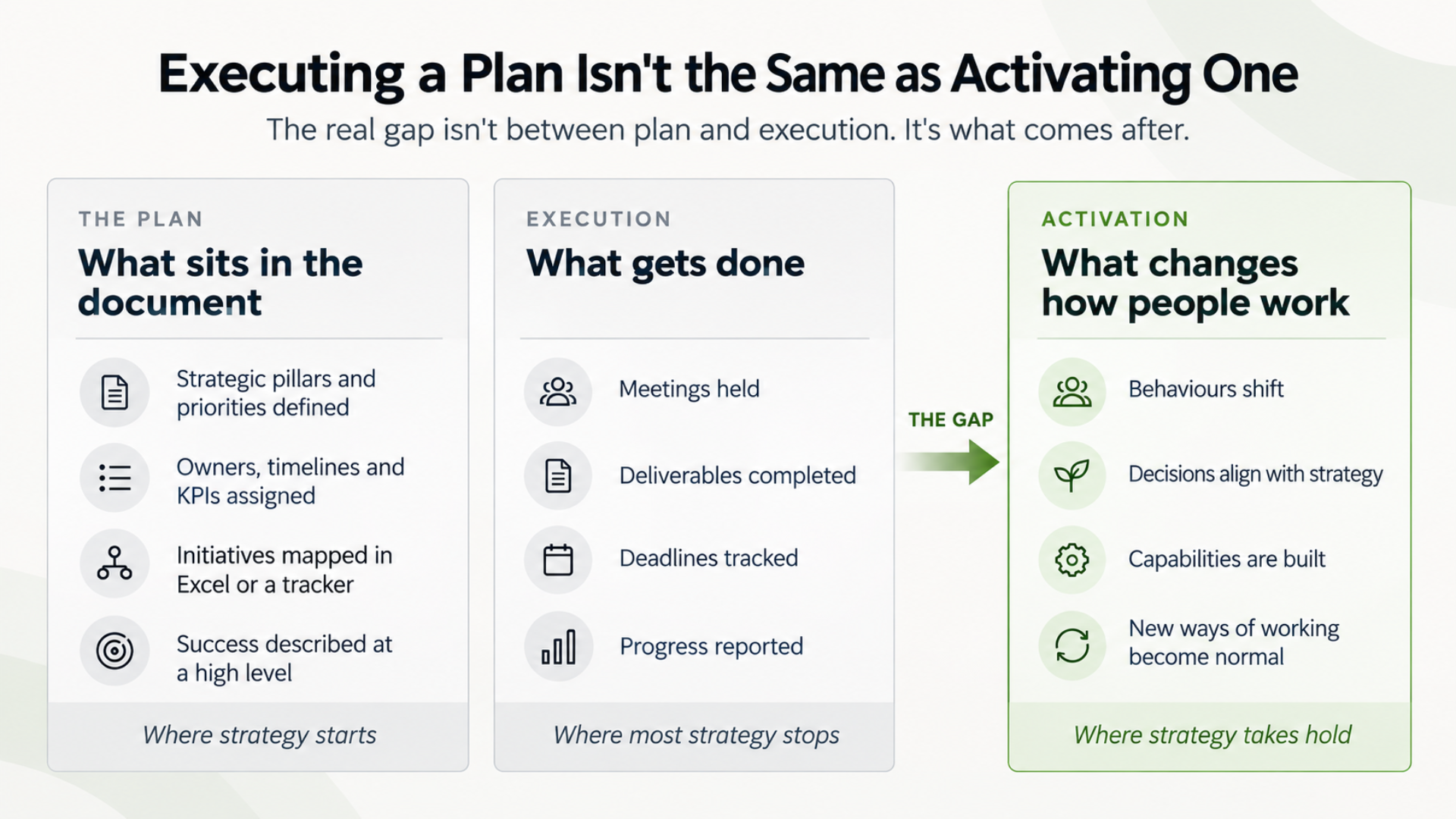
I mean deliberately identifying the measurable behaviours that need to change, building opportunities for people to learn and practice them, and then measuring whether those behaviours are showing up in the work.
A year into a strategy, a leader should be able to look around the organization and see differences in how people behave, make decisions and prioritize.
What are leaders using to guide decisions?
What are frontline employees prioritizing differently?
What conversations are happening that did not happen before?
What behaviours have become normal that would have been unusual a year earlier?
If nothing about the day-to-day work has changed, then the strategy is not driving change. The organization is simply executing activities.
Start with strategy, then work down to behaviour
When I build activation programs with clients, I use an Impact Value Chain.
We start with the strategic priority and ask: What would we need more or less of from our people for this to actually happen? That identifies the competencies we need to build.
Then we make those competencies observable. What would someone actually be doing differently if they became better at this?
For example, imagine an organization wants its leaders to make more strategic decisions. “Strategic decision-making” is still too vague to activate, so we keep going.
Perhaps one observable behaviour is that when a team is considering a significant decision, the meeting chair presents the relevant OKRs or KPIs and the team explicitly considers the decision against them.
Now we have something we can work with.
From there, I work backwards to determine what people need to learn, practice and discuss so that behaviour becomes part of how the organization operates.
The content is the catalyst. The behaviour change is the point.
This is where activation becomes very different from simply deciding that your leadership team needs a course on strategic thinking and hoping something sticks.
Generic aspirations make activation harder
There is another issue underneath all of this - you need a strategy worth activating.
Take “client-centred service” or “operational excellence.” Almost every social service organization I know would say it wants both.
There is nothing wrong with that. You absolutely should deliver client-centred services and operate effectively.
But those statements alone do not distinguish you from the organization down the road.
This is where I pull on Roger Martin and A.G. Lafley’s Playing to Win: How will we win?
How are you delivering client-centred service in a way other organizations cannot? What is your competitive advantage? What are you choosing to become particularly good at? Is it easy for someone else to replicate?
And then there is another question I think organizations need to ask more often: how will we do this better than we did last year?
A strategy should stretch the organization in some way. It should require you to build capability, make different choices or operate differently.
If your new strategic plan can be delivered using exactly the same behaviours, capabilities and decision-making patterns you used under the previous one, I would question how much change the strategy is actually asking you to make.
Activation takes longer, but you should see the needle move early
Part of the reason execution is so attractive is that we get an immediate payoff: Task complete. Box checked. On to the next thing.
Activation requires us to stick with something while people learn, practice and get habitual at doing things differently.
We also live in a culture obsessed with productivity and efficiency. How can we do more in less time? AI is pouring fuel on that question right now. Many organizations are looking at AI because they want to reduce burnout, ease caseload pressures and create capacity.
But AI can also simply speed up the hamster wheel. Doing more, faster, is not necessarily transformation.
I have learned through years of leadership and strategy work that slow is often fast. When we get intentional about where we want to be a year from now, map out what it will take to get there and build the skills required along the way, we create far more traction over the long term.
That does not mean waiting twelve months to find out whether anything worked.
In the activation programs I build, we look for movement within the first 30 days and use the data to guide what comes next.
With clients, I have seen increases in willingness to have hard conversations, collaboration, engagement and accountability. I have seen resistance to new initiatives decrease, adoption of new ideas accelerate, incident reports decline and people become more willing to make the decisions that belong within their role rather than escalating everything to a supervisor or CEO.
Those are early signals that something underneath the strategy is beginning to shift.
Want to know if your strategy is activated? Ask your people.
Here is a simple place to start.
Randomly ask a few frontline employees or middle managers what your strategic pillars are. Ask what your strategic goals are or which KPIs matter to their department.
Do not prompt them. See what they say.
Because you cannot have a strategic organization, with people from the frontline through to senior leadership making strategic choices, if they do not understand what they are measuring those choices against.
Then go further.
If you have an autism services team, what do the strategic pillars actually mean for them? Does their manager know which KPIs apply to their department? Can the team recognize how the work they do every week contributes to them?
When I was a program manager, I started every team meeting by taking about ten minutes to go around the table. Each employee named one activity they had done that week that aligned with one of our key strategic pillars.
After a couple of months, several staff told me it had become their favourite part of the meeting.
It gave them a reason to come out of the weeds of the clinical work for a moment and think about the bigger picture. They could see how their individual work contributed to something larger.
That is a small example of activation, but it gets at the distinction.
Execution makes sure the meeting happens. Activation changes what people do inside it.
And over time, that is how a strategy stops being something your organization has and starts becoming something your organization does.