
Why Did My Strategy Plan Fail?
A leader I worked with had a strategy they were proud of. Tens of thousands of dollars to a name-brand consultancy, and a polished deck laying out a clear three-year direction. Eighteen months later, almost none of it had happened. The plan was good, the binder was beautiful, and yet it was still sitting on the shelf where the consultants left it.
This is not unusual. If you want to understand why strategic plans fail, you have to start with an uncomfortable fact: the failure almost never happens at the whiteboard. It happens afterward, in the long quiet stretch between a plan being approved and anyone actually changing what they do on a Tuesday morning.
That gap is where most strategy goes to die. And it is bigger than most leaders want to admit.
The number nobody puts in the deck
Michael Mankins and Richard Steele studied this for Harvard Business Review back in 2005, drawing on research across a large set of companies. Their finding has held up uncomfortably well: organizations deliver, on average, only about 63% of the financial performance their strategies promise. More than a third of the value leaders are counting on simply evaporates somewhere between the plan and the result.
Notice what that figure is not saying. It is not saying the strategies were wrong, it’s saying that even sound strategy leaks value on the way to execution. The thinking was fine, the translation broke down.
Other research points the same direction. A multi-year Harvard Business Review study by Donald Sull and his colleagues looked at more than 250 companies and found that only half of middle managers could name even one of their company’s top five priorities. Sit with that. These are the people you are relying on to carry the strategy into the actual work, and half of them cannot tell you what the strategy is.
So when we ask why strategic plans fail, the honest answer is rarely “we picked the wrong direction.” It is closer to “we never built the bridge from the direction to the day-to-day.”
We blame execution, but we usually mean the wrong thing
Here is where it gets interesting, because the standard diagnosis is half right and half lazy.
When a plan stalls, the post-mortem almost always lands on execution. The team lacked discipline, or people did not follow through. And sometimes that is true.
But Sull’s research pulled apart what “execution” actually means, and most of our assumptions about it are wrong. We assume execution is about alignment, getting everyone marching in the same vertical line from the top down. The real breakdown was horizontal. People could not rely on commitments from colleagues in other departments. The strategy did not fail because the hierarchy was misaligned, it failed because the handoffs between teams quietly fell apart.
We also assume execution means sticking rigidly to the plan, when the strongest performers adapted as conditions shifted. And we assume that because we communicated the strategy, people understood it. Sending the all-hands email is not the same as someone reorganizing their week around a new priority.
Andrea Belk Olson made a related point in Harvard Business Review in 2022, and it is the one leaders find hardest to hear. Sometimes the strategy itself was never built for execution in the first place. It did not account for the organization’s real capabilities, the pressures that cannot be moved, the culture it had to land in, or even a clear read on the problem it was meant to solve. A plan designed in a vacuum will fail in contact with the actual building, and we will call that an execution problem because that is more comfortable than calling it a design problem.
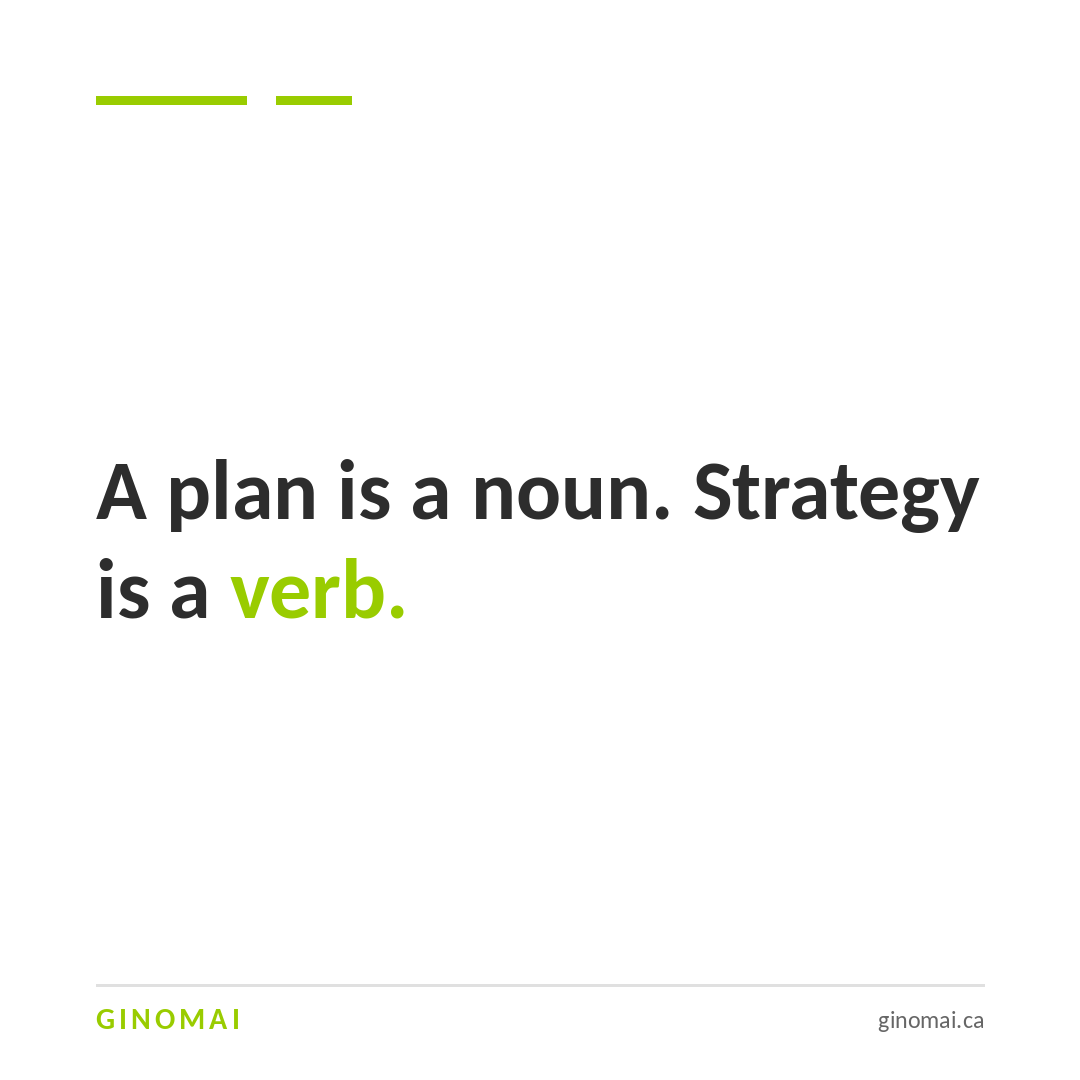
A plan is a document. Strategy is a behaviour.
This is the reframe I keep coming back to with clients.
A strategic plan is a noun. It is a thing you can print, approve, and file away. Strategy, the kind that actually changes a business, is a verb. It is what people do differently because the plan exists. And those two things are far less connected than the planning process pretends.
The forty-thousand-dollar binder failed for exactly this reason. It was a flawless noun. Nobody had touched the verb. No one had asked what specific behaviours would have to change, whose week would look different, what people would have to stop doing to make room for the new direction, and who would notice if they did not.
That is the work that gets skipped, because it is harder and less glamorous than the strategy offsite. It does not produce a deck. It produces small, awkward changes in how people actually operate, sustained long enough to stick, and it requires someone to stay in the room long after the consultants have invoiced and gone.
What actually closes the gap
So if the plan is not the problem, what does the work look like? After enough years seeing plans that never launched, I have come to think activation rests on a few things that rarely make it into the strategy document.
It starts with naming the behaviours, not just the goals. “Grow the fee-for-service segment” is a goal. The behaviour is the three things your program leads now do differently every week, and the two old habits they drop to make space. If you cannot describe the change at the level of someone’s Tuesday, you do not yet have a strategy you can execute. You have an aspiration.
It depends on ownership rather than buy-in by announcement. People carry what they helped build and quietly resist what was handed to them finished. That is one of the most durable findings in organizational research, going back to the participation studies of the 1940s and reinforced by decades of work on motivation since. If your rollout plan is mostly about getting people to comply, you have already lost the part that matters. I go deeper on this in how to get real buy-in for change.
It treats implementation as a system, not an event. The launch meeting is not the finish line. It is barely the starting line. What carries a strategy forward is the set of routines and feedback loops that keep the new behaviour alive until it stops feeling new. That is its own discipline, and it is the focus of strategy implementation that actually sticks.
And it accepts that training alone will not get you there. This is the trap I see most often with AI right now, where organizations run a workshop, declare the team enabled, and wonder why nothing changed. Knowing how to do something and reliably doing it under pressure are different problems, and the gap between them is exactly where most change initiatives stall. That pattern deserves its own piece, which is why AI training isn’t changing behaviour.
The real question
Most leaders I meet don’t have a strategy problem, they have a strategy that is technically excellent and behaviourally inert. The plan is right, but nothing is moving.
That is the work I do at Ginomai, and it is why I keep using the word activation instead of planning. Closing the distance between a good plan and changed behaviour is a discipline of its own, and it is the part the planning industry quietly leaves on your shelf. If you have a plan that looked great in the room and has gone nowhere since, that gap is fixable, and it is most of what my services are built to do.
So before you commission the next plan, it is worth asking the harder question about the last one. Not whether the thinking was good. Whether anyone’s Tuesday ever actually changed.