
What Does Strategy Activation Actually Mean?
Picture this: your organization rolls out ChatGPT Enterprise. Leadership signs off on a policy, comms goes out, everyone gets a login and a "go ahead, use it" from the top.
Six months later? A handful of power users have quietly built it into how they work. Everyone else is dabbling — a summary here, a first draft there — in silos, with no shared sense of how any of it connects to anything bigger than their own to-do list. Some leadership teams have even gone so far as to name "AI" itself as a strategic priority. Which raises the obvious question: what does that actually mean? AI isn't a line item you slap onto a strategy document. It's not a piece of software you license and walk away from.
If this sounds familiar, you don't have an AI problem. You have a strategy activation problem — and AI just happens to be the version of it that's impossible to ignore right now.
The Gap Nobody Puts in the Plan
Here's what I see constantly: organizations bring in a firm, pay a serious amount of money, and walk away with a strategy document. Pillars, priorities, KPIs — all there, all logical, all signed off by the board.
And then... not much changes. A few things shift at the surface — a town hall, an org chart update, maybe a new dashboard — but the actual way people do their work, day to day, stays exactly the same.
That's the gap. Strategy activation is the work that lives in that gap, between the document that says what you're going to achieve and the organization actually achieving it.
It's not the same as "execution," at least not how most people use that word. Execution sounds like a project plan: deliverables, owners, deadlines. Activation is what has to happen underneath all of that — the capabilities your people need to build, the behaviours that need to change, the resources that need to actually be accessible (not just budgeted for), and the very human work of helping people understand what this means for them on Tuesday.
Because that's the question every employee is actually asking, whether they say it out loud or not:
What's changing?
Why does it matter?
What do I need to do differently — starting now?
If you can't answer that for the people doing the work, your strategy document is a very expensive piece of paper.
Why Most Activation Attempts Stall
A town hall is not activation. Neither is an email, a policy, or a tool rollout. Those are announcements. Activation is what happens after the announcement — and it's where most organizations quietly give up, because it's the part nobody put a line item against.
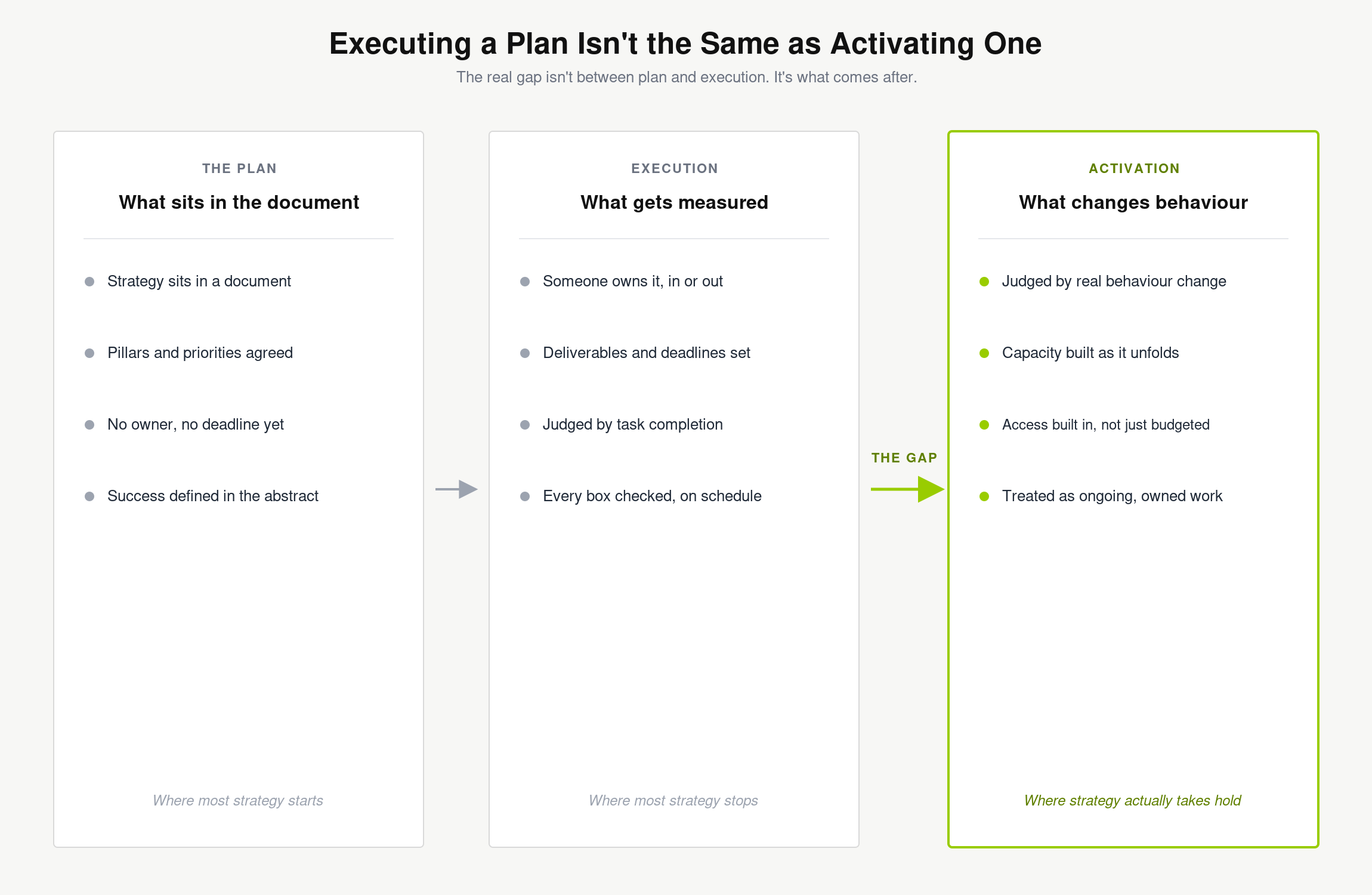
Done well, activation includes people in the process rather than just informing them. It looks like:
Training that builds the new capabilities the strategy actually requires
Room to practice new behaviours and reflect on what's different
Recognition and celebration of early wins, because momentum matters
Space for failure, because some of what's in that strategy document won't work as written
A strategy plan that can't flex when the data says "this isn't working" isn't a strategy — it's a museum piece.
Most activation attempts skip straight from "here's the plan" to "here's the training," without ever doing the work of figuring out what capabilities and behaviours actually need to change, or whether the systems underneath the organization can even support the shift being asked for.
A Framework for Closing the Gap
This is the work I structure into three phases.
Define
Define is where you figure out what's actually worth activating. Most organizations have more strategy sitting on a shelf than they've ever implemented — including work they've already paid for and never used. We review what exists, run discovery workshops with the leadership team, and get specific about the gap between what was planned and what's actually getting in the way.
Manage
Manage is where you build the infrastructure — the systematic and behavioural frameworks the organization needs to actually execute on what was defined. Not a generic playbook pulled off a shelf. Built for this organization, this context, these constraints.
Transform
Transform is where it becomes real. This is the behavioural change work — leadership competency modules, capability programs, executive-level sessions — run alongside measurement at every stage, so you know whether the shift is actually happening, not just whether people showed up to a session.
Back to AI — And the Part That Should Worry You
Here's where I'll push back on how most organizations are approaching this: AI integration is the cleanest live test of strategy activation happening right now, and most organizations are failing it in a completely predictable way.
A good AI policy and enterprise-level access is not an AI strategy. It's a green light. And a green light with no map doesn't get you anywhere — it just means everyone drives in a different direction, at a different speed, and a lot of people don't drive at all.
If your people don't know how AI is meant to support the specific goals you've set — and don't see, in their own role, where they should and could be using it — your AI integration plan will die. Quietly. Not with a failure announcement, just a slow drift back to "the way we've always done it," while leadership wonders why adoption numbers look so flat.
And underneath all of it: AI is only as good as the systems it has to work with. If your digital environment — your files, your processes, your documentation — is a mess, AI won't fix that. It'll just make the mess more visible, faster.
True AI integration that stays siloed to a handful of enthusiastic individuals will hit a ceiling fast. The benefit stays trapped in their role and never reaches the rest of the organization — which means the investment never reaches the outcome it was meant to support.
Where To Start
If any of this sounds like where your organization is right now — strategy written, tools purchased, and a quiet sense that none of it has actually moved the needle — the place to start isn't another policy or another training rollout.
It's getting clear on where you actually stand and finding strategy activation support that's built around how your organization actually needs to move. That’s what my AI Readiness Diagnostic is built for too: a way to surface whether your organization is genuinely positioned to integrate AI against the goals you've set, or whether you're about to repeat the exact same activation gap with a brand-new tool.
Because the strategy document was never the hard part. What happens after it is.