
How Do I Communicate Strategy to My Team?
I've been in more strategy town halls than I can count and I've watched staff file out of them feeling anxious and unheard.
I've heard senior leaders debrief afterward with comments like "They just don't get it. They have no sense of the business realities we're up against."
I've also heard the mirror image from frontline teams: ""Leadership doesn't understand what we're dealing with every day. They just care about the numbers."
Both things are usually true, and both are symptoms of the same problem.
Strategy communication, in most organizations, is treated as an announcement. A decision gets made at the top, packaged into a presentation, and delivered to the people who are expected to implement it. The logic seems reasonable — leadership has the context and the authority, so they decide, then they tell. But this approach skips the most important factor in whether change actually takes hold: whether people experience it as something happening with them or to them.
The Difference Between Telling and Involving
When people receive news of a change they had no part in shaping, they experience it as something happening to them, and when that's how it feels, resistance is the natural and rational response. Resistance in this context isn't obstinance, it's self-protection.
The antidote is involvement. When the people who are expected to make changes are brought into the process early — when their perspectives are genuinely considered and their questions are treated as assets rather than obstacles — buy-in follows. Not because you've convinced them, but because they've been part of the design.
This reframe matters: strategy communication doesn't begin at the townhall. It begins weeks, sometimes months, before the announcement.
The Perception Gap That's Stalling Your Org
This dynamic is especially pronounced in nonprofit and government-funded organizations, where funding cuts and policy shifts are constant. Frontline staff often understand there's been a funding cut, but they don't have visibility into what that means at an organizational level — and frankly, that's not their job. Meanwhile, senior leaders are making impossible decisions under pressure and can't understand why their teams seem fixated on what feels like the wrong things.
The frustration runs both ways and the misunderstanding is structural, but it is the senior leader's responsibility — not the frontline's — to close that gap.
Before the Town Hall: Create Space for Real Input
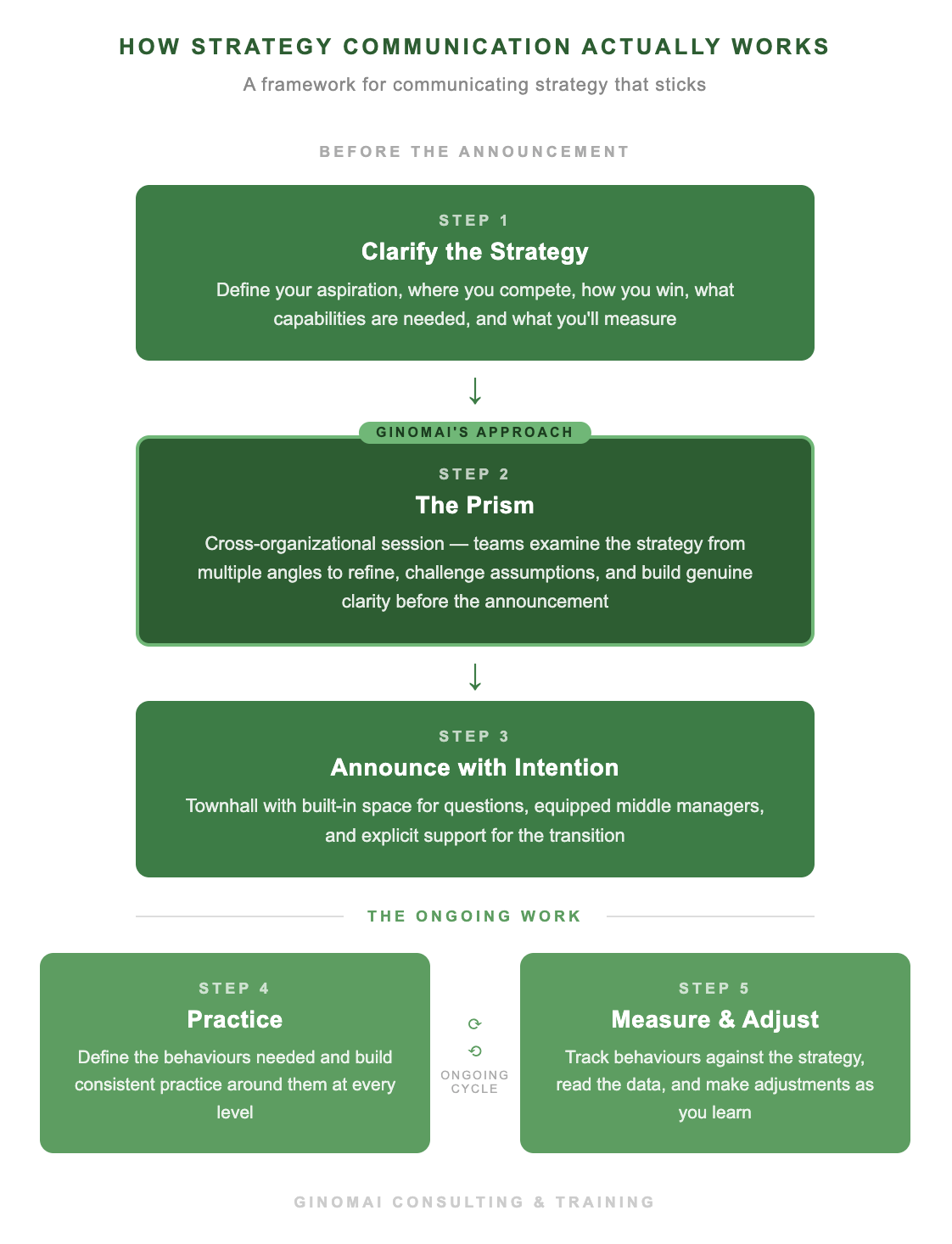
One of the most practical changes a leader can make is to stop treating the town hall as the beginning of the conversation and start treating it as a milestone in the conversation.
The Prism
Before any major strategic announcement, run what I call The Prism — a structured session where cross-organizational teams examine the strategy from multiple angles before it's finalized. The goal is clarity and refinement: what does this look like from where you sit, what are we missing, what needs to be adjusted? Each perspective that enters the room refracts the strategy into something sharper and more complete than any single viewpoint could produce.
Edward de Bono's Six Thinking Hats is a useful tool here. By asking people to think through a change from multiple angles — facts, emotions, risks, opportunities, creative possibilities, and process — you pull people out of their default positions and into more productive territory. This isn't a venting session or a complaint forum. It's a disciplined thinking exercise that challenges people to move beyond their own bubble and consider what the strategy really requires, what genuinely needs to change, and what hasn't been considered yet.
The goal isn't consensus — it's a better-informed strategy and a team that felt heard before the decision was finalized.
A Framework for What You're Actually Communicating
Communicating strategy well requires being clear on what the strategy actually is — which sounds obvious, but rarely is in practice.
I like this five-part framework that draws on the work of strategist Roger Martin:
Aspiration: What is your purpose? Why does your organization exist, and what does winning look like?
Where to play: Where are you focusing? What geography, population, service area, or channel?
How to win: What is your actual competitive advantage — and "excellence of care" is not an answer. Every human services organization claims that. What do you do that others don't, or can't?
Capabilities and behaviours: What do your people need to be doing differently to achieve this? What skills, practices, and ways of working are required — and how are you helping them build those?
Management systems: What will you measure? How will you know if it's working?
This framework matters because it gives people at every level a way to locate themselves in the strategy. It moves the conversation from abstract vision statements to concrete daily behaviours.
Strategy Is Not a Launch — It's a Practice
Here's where most organizations fall apart: they communicate the strategy once and then assume the work is done.

Research on strategy execution consistently shows that most employees cannot articulate their organization's strategy 90 days after it's been announced — not because they weren't listening, but because strategy communicated once, without reinforcement, does not stick.
At Ginomai, this is where our work lives. Once we've identified the capabilities the organization needs, we define the specific behaviours people need to be engaging in, build practice around those behaviours, measure progress, and adjust based on what the data tells us. Strategy becomes a living system rather than a shelf document.
If you communicate a strategy without a practice and measurement loop, you've delivered a presentation, not a strategy.
The Emotional Work Leaders Skip
Change is not a light switch, and yet many leaders — myself included, if I'm being candid — want to flip it and move on. We're energized by the vision and have already done our own processing. We're ready to go.
Our teams aren't. They're just getting the news.
Effective strategy communication means building in time for people to absorb, question, and sit with what the change means for them personally. This requires more than one session. It requires leaders who can hold space for discomfort without interpreting it as defiance.
It also means being explicit about a few things from the start:
How you will be supporting people through the transition — so they don't feel like the change is being dropped on them with a "figure it out" attached
That mistakes and missteps are expected and acceptable as people adjust their behaviours and systems
That feedback is not just permitted but actively wanted, and that the plan will evolve based on what you learn
The best strategy in the world will run into something no one anticipated. Having clear language and expectations around how that will be handled — before it happens — is what separates organizations that adapt from organizations that spiral.
Your Middle Managers Will Make or Break This
Senior leaders often do a reasonable job of communicating strategy to their direct reports. What they underestimate is what happens next, as that message travels through the layers of the organization.
Middle managers are the critical translation layer. They're the ones their teams will actually talk to, push back on, and look to for reassurance. And they are frequently not equipped to do that job.
Equipping middle managers means more than sending them a copy of the slide deck. It means training them to hold honest conversations (not meetings) with their teams. There's a meaningful difference: a meeting can be one-directional and managed, while a conversation requires the ability to hold a team member's concern and a performance expectation in the same breath.
Leaders who can communicate clearly and manage disagreement with confidence tend to bring their teams through change intact. Leaders who can't often find their teams spiralling — resistance deepening, trust eroding, the strategy stalling before it ever starts.
This is not a soft skill — it's a strategic capability, and it deserves to be treated like one.
To the Leader Who Thinks They Don't Have Time for This
I hear this objection often: "This all sounds good, but I need my people to execute. I don't have months for all this."
My honest response: good luck managing the resistance and the failed change initiative that follow.
Effective change doesn't happen overnight or by flipping a switch. Cultures that can move through change with speed and agility — where people trust leadership, ask good questions, and adapt without unravelling — take years to build. They are built precisely through the kind of investment in communication and people that leaders short-circuit when they're in a hurry.
The time you spend involving people early isn't a delay — it’s the work, it’s the strategy activation.
Start Here This Week
You don't need a new strategy to start communicating better. You need a baseline.
Find three people on your team and ask them, without any prompting, to tell you what your organization's strategy is and what the key pillars are. Can they name them? Can they connect those pillars to something they did this week?
If they can't, you have your answer — and it's not about them, it's about the communication.
Then, in your next team meeting, try this: review the strategy together, and ask every person to name one thing they did this week that aligned with the strategic plan. One thing. That single practice, repeated weekly, begins to close the gap between strategy as document and strategy as lived reality.
That's where it starts — not with a better deck, but with a different kind of conversation.