
What's The ROI Of Strategy Consulting?
A board wants a number. That's a fair thing for a board to want, and it's also the wrong question to start with. When a leader asks me what the ROI is on strategy consulting, they're usually trying to build a case for a room full of people who think in dollars and quarters. The honest answer isn't a single percentage. If it were, someone would have skipped a step. The plan itself is a small part of the investment. The return depends entirely on what happens after the board approves it.
Too many organizations get the plan on paper and believe they've done most of the work. Writing the strategy is the easy part. The work that actually produces a return is translating that plan into the capabilities, competencies, and behaviours your people need to engage in to achieve what you set out to achieve. That translation is what gets missed, and it's what a board should be asking about before they ask for a percentage.
Where the return actually lives
Organizations will hire an agency to write a strategy plan without asking how it's going to get activated. It's one thing to have pillars on your website and a document the board has signed off on. It's another thing to still be executing on it in five years, instead of explaining to that same board why nothing on it happened.

Good ROI on a strategy project includes an implementation plan, and a consultant willing to walk you through measuring it, proving that behaviour has changed and goals have been achieved. That starts with clarity most organizations skip over. Boards need to see clear objectives with a real number attached. "We'll have more children coming through intake" isn't a workable goal, because nobody knows what "more" means or when they've hit it. Something as simple as the SMART framework gives a team clarity on what they're aiming for and how they'll know they got there.
From there, the questions get more specific. What are your people doing differently on a Tuesday morning because of this plan? What systems and processes let that change happen with the least friction? Is anyone training your middle managers, who are the ones actually communicating these new ways of operating down to the front line, and reporting back up on where the needle is moving?
How we actually measure it
Before any of that work starts, we get clear on the capabilities a goal requires and what needs to be true, behaviourally, to get there. "We want our leaders to manage conflict well" is a real goal and a real capability. It isn't a behaviour yet. The work is naming what people actually do differently when they're managing conflict well, then having them practice those specific behaviours over a 30-day period using a habit and behaviour-change technology, and measuring their progress alongside it. We align those behaviours to the organization's strategic priorities, and that's what lets us show where change is happening in a way that connects back to the strategy itself, rather than measuring activity for its own sake. Before any of that, we run workshops that introduce the competencies inside the organization's own context, because people need a reason to change that isn't just a manager telling them to. What's in it for them is one of the most important questions to answer before you ask anyone to do something differently.
What this produces in practice
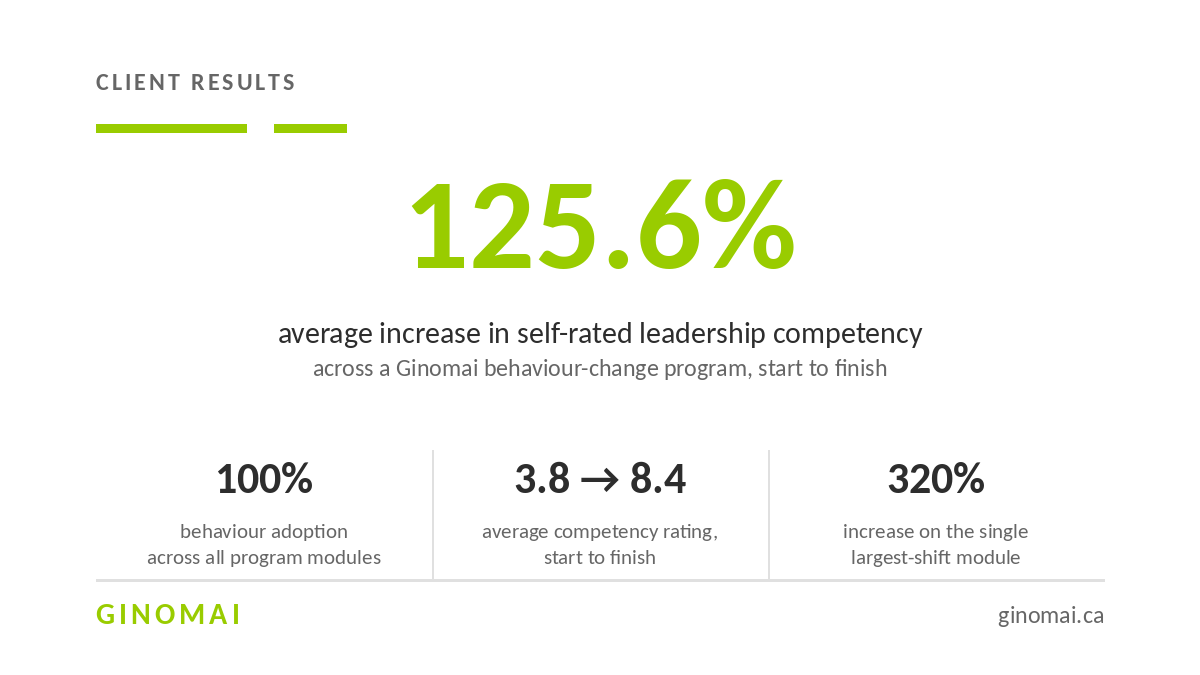
One client, a nonprofit running a leadership behaviour-change program with us, shows what this actually looks like. Across four program modules, adoption of the committed behaviours reached 100%, and most participants had an accountability partner tracking progress alongside them. Self-rated competence started at an average of 3.8 out of 10 and rose to 8.4 by the end of the program. One module, focused on following through on tasks and changes with the frontline team, moved from a rating of 2.0 to 8.4, the largest shift in the program.
The organization's CEO reported, separately from this data, that she's seeing more accountability on her team, better decision-making, and fewer risky situations. Her people are owning their responsibilities, and she's checking in on them less. Her read on the change lines up with what the behaviour data shows. Neither one proves the case on its own. Together, they do.
The misconception that costs boards years
There's still a belief that a couple of offsites, some training days, and maybe a staff appreciation event will get a culture ready to embrace whatever change comes next. Leaders talk about the need for transparent communication and giving people time to absorb change. Many of them still don't practice it. They run the town hall, announce what's changing, and expect people to be fine with it. When people aren't, leadership gets frustrated instead of curious about why.
If your organization sets a five-year plan, the working assumption should be that it takes five years, with regular check-ins and adjustments along the way. Instead, many leaders assume that once the direction is communicated, it will simply happen. Then a funding cut or a policy shift gets in the way, and the plan gets written off as no longer relevant, because it was treated as a fixed document instead of a working draft held loosely enough to adjust. You don't have to wait five years to see a return. You can see it well before then, but only if your goals are measurable and you're actually measuring them, across every team, on a regular basis.
Translating it into the board's language
Behaviour data like the numbers above is real evidence something is changing, and you can see it months before any financial figure would surface. It still isn't the dollar amount a board or CFO ultimately wants. The credible way to bridge the two is to name the business metric you want to move, such as turnover or incident rate, before the project starts, then compare that baseline to where you land at the end.
The complication most organizations run into is that they aren't tracking that baseline to begin with. If you can't say what your turnover rate was before a leadership program started, you can't isolate what the program changed, and that gap is worth naming to your board directly. It means the ROI conversation has to start with better measurement, not a bigger deck. For organizations that are tracking it, the number is real and current: the average cost of employee turnover in Canada is now $30,680 per departure. A program that measurably improves retention on even a handful of roles recovers a meaningful share of its own cost before you've touched a softer metric.
Until that dollar figure exists, behaviour change is legitimate evidence on its own, not as a stand-in for the financial case, but as proof you're on track while the slower numbers catch up. If your board has approved a plan and nobody can point to what's actually different because of it, that gap is fixable. Closing it is most of what my services are built to do.