
When Should My Nonprofit Hire a Strategy Consultant?
Most nonprofit leaders I talk to have already answered the "should I outsource this" question before they even sit down with me. Strategy gets treated as a business activity, and a lot of leaders in this sector didn't come up through business, so it feels natural to bring someone in from the outside to build the plan. Add a board that's asking for one because it's best practice, and you've got a strategic plan on the shelf within a year.
So if that part is already happening, why does this question keep coming up? Because having a plan and being able to execute it are two completely different problems, and almost nobody is talking about the second one.
Why "should I hire a consultant" is the wrong starting point
The question isn't really planning versus internal resources. By the time I get called in, there's usually already a strategy document, sometimes even a fairly good one. The organization knows where it's trying to go, because that's written on the website somewhere. What's missing is a credible way to get there.
Where I'm actually needed is activation. Leaders are running organizations through funding cuts, thinning staff, turnover, and policy shifts that keep forcing them to think more like a business while their teams are nowhere near ready to operate that way. In that environment, strategy gets done off the side of the desk. Leaders tell me they're managing it themselves, and when I ask how it's going, the answer is always some version of the same story: reactionary decision-making, measurement that isn't actually useful, and no real clarity on the path from where they are to where they said they wanted to be. The plan looks solid on paper. The definitions underneath it, the tasks, the outcomes, the way success gets measured, are loose. The organization has everything it needs on the surface, but not the people capacity or the tactical capacity to make any of it happen.
The real problem isn't the plan, it's the activation gap
Strategy is not something you pick up when you remember to. It's an ongoing project, and it needs an owner, whether that's an external partner or someone internal whose job it actually is. That single shift in thinking, from "we have a plan" to "who owns making this real," is the difference between an organization that executes and one that's still ticking boxes a year later.
What nobody's measuring, and why it matters
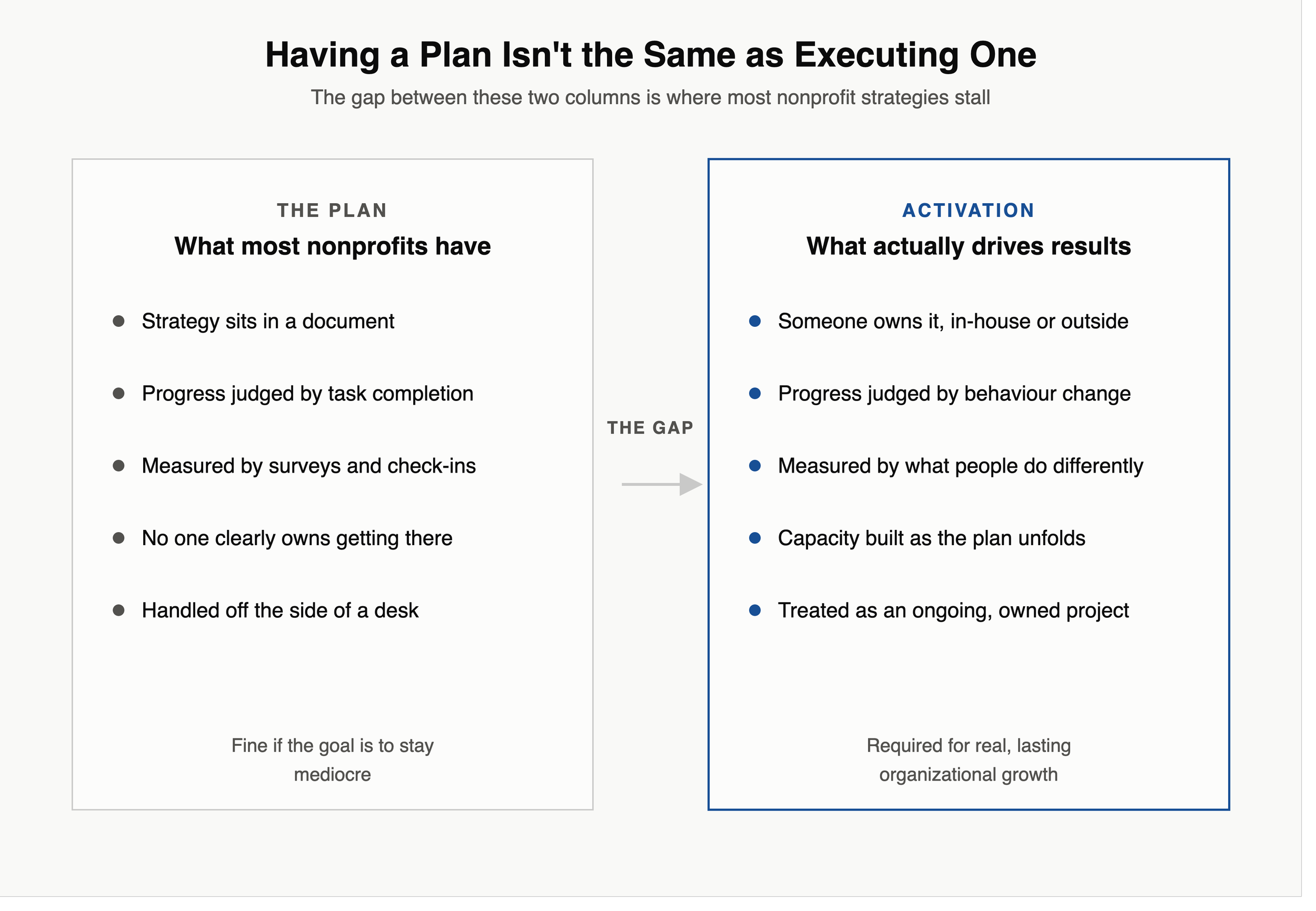
This is the part I see missed most often. Most organizations measure progress through feedback conversations and staff surveys, and the surveys are frequently designed so poorly that the results don't reflect reality at all. What actually tells you whether a strategy is working is behaviour change. What are your people doing more of, less of, more accurately, or more consistently, in direct relation to the strategy? That's the read you need. It tells you not just whether you're on track, but exactly where you need to upskill people and build system capacity so execution is even possible.
There's a common misconception underneath all of this: that strategy is a list of tasks to complete. That's fine if your ambition is to stay mediocre. It doesn't work if you want to be a high-performing organization with a reputation as the go-to name in your community. That level of performance requires a real commitment to capacity building, because that's what evolution actually is. It's growth, and growth only happens when you deliberately create the space for it.
When you can actually do this internally
If your organization has a business or operations director, or someone in an equivalent leadership role, they can own this work internally, and they should. But that only works if there's also a real plan to build capacity across the team and to measure behaviour change along the way, not just to hand someone the strategy document and hope. If that role doesn't exist in your organization, it's worth seriously considering bringing in external help to bring that capacity in from outside, at least until you can build or hire for it.
Where hiring external help goes wrong
Hiring a consultant doesn't automatically solve the activation problem either. I've seen a few patterns show up again and again:
Organizations hire someone for the planning phase, then don't do the follow-through work they were tasked with, or spend most of their energy resisting the change execution actually requires, whether that's understanding financial implications, thinking about market position, or figuring out how to distinguish themselves from every other organization claiming "excellence of care."
Organizations hire only for the design of the strategic plan document itself, then try to execute it entirely on their own and struggle to stay on track without any outside accountability.
Organizations build the plan themselves, underestimate what they're actually capable of, hit their five-year goals in two years, and then have no idea what comes next. I've been brought in after this exact scenario, to help design the next plan so the same underestimation doesn't happen twice.

What all of these have in common is that they miss the real value of bringing someone in from outside: an external perspective that can challenge your thinking precisely because it isn't shaped by your culture, and that's focused entirely on helping you hit your goals rather than being pulled in ten directions the way anyone leading a nonprofit inevitably is.
The question to ask yourself this week
If you're reading this and recognizing your own organization, here's where to start. Are you honestly on track with your strategic plan, and can you measure your progress in a way that gives you real clarity on what's working and what isn't? Do you have clarity on how your people are actually supporting the work, and what competencies they still need to build to get there?
If you haven't thought through those two questions, you're probably ticking boxes rather than generating the kind of impact and lasting change that moves your organization forward. And that's the real signal for whether you need help, whether that's an external partner or an internal hire dedicated to owning this work. Not whether you have a plan. Whether anyone is actually driving it.